Changing places: Responsibility, nostalgia, and the right to complain | BiteX: War

Who has the ‘social licence’ to claim a place has changed for the worse? Does it matter if that change is driven by tourist visas, employment visas, or permanent migration?
Is ‘nostalgia’ a valid stakeholder in a destination’s future? And does travel & tourism have a responsibility to validate these feelings, or is change simply the price of ‘progress’?
Thanks to the six respondents for their considered thoughts. Their responses are listed in the order I received them. For BiteX, a few of us ponder war.
Bites menu
Who gets to define ‘overtourism’?
Pham Phi Anh, Deputy Head of Project Development — Fundraising Unit, Anh Duong Center, Vietnam
In community-based tourism, the most important question is not how many visitors arrive, but who decides what is ‘too many’.

Through the Anh Duong Centre’s work with rural communities in the Mekong Delta and southern Vietnam, we have learned that ‘over-tourism’ is rarely defined by statistics. It is felt in daily life.
In one Mekong Delta village where women operate small homestays, families initially welcomed as many guests as possible, and income rose quickly. But after one busy season, several women admitted they were exhausted. Farming routines were disrupted, and time with children became limited. The group agreed to cap guest numbers; not because tourism was failing, but because balance mattered.
In another southern community, handicrafts once made for household use shifted towards designs tailored for visitors. Sales improved. Yet some elders worried that cultural meaning was thinning. The real question was not whether adaptation was wrong, but who should decide how far adaptation goes.
Businesses count occupancy rates. Authorities count growth. Visitors see vibrancy. Residents feel the strain.
So, who holds the social licence to say a place has changed for the worse?
In our experience, those who live with the consequences every day must carry the greatest weight. Nostalgia is not simply resistance to progress. It can signal that identity, dignity, or belonging feels fragile.
If tourism professionals are uncomfortable giving residents real decision-making power, then we must ask: are we pursuing ‘good tourism’, or more tourism, better packaged?
‘Overtourism’ is not about numbers. It is about who gets to choose the future, and who must live with that choice long after the visitors have gone.
Anyone has a ‘social licence’ to claim a place has changed for the worse
Richard Butler, Emeritus Professor of Tourism, University of Strathclyde, Scotland
I would argue anyone theoretically has a ‘social licence’ — whatever that is — to claim a place has changed for the worse in their opinion. We may well feel strongly about certain places and deeply regret the change that has occurred there. We do not need to live there to feel that way.

Much depends on the nature of the change. To me, most modern architecture rarely enhances existing places and is often an eyesore, so I feel I have the licence to comment to that effect.
Clearly, residents complaining of change may argue they have a greater right to complain. If they are blameless but negatively affected by change, good for them. But if they have sold up, cashed in, and moved out, they lose some degree of righteousness for complaining that Airbnb, or similar, is ruining where they used to live.
Much of the complaining is probably related to the frequent feeling of being unable to halt or modify change; if people are even notified in advance.
Nostalgia as such cannot be a valid stakeholder. However, nostalgia is a vitally important element in many people’s lives and should not be treated as valueless. It is a factor in our existence. It brings comfort, and even security, to those of an advanced age to be able to look back with pleasure and revisit — even if only mentally — old venues. To find them changed greatly with apparently little thought or reason, beyond some agency’s bank balance, can be very depressing.
The world does not stand still. But change should surely always be designed with the aim of a more appropriate, safer, cleaner, equitable, friendly, and welcoming setting for residents and visitors, rather than simply for the sake of change or to make a little more money.
The social licence question is about who gets to decide
Ewan Cluckie, Chief Growth Officer, Tripseed, Thailand
Local residents. Full stop. They are the ones who live with the consequences: Rising real estate costs, crowded infrastructure, cultural erosion, and environmental degradation.

I do not think it matters whether those pressures come from tourists, expats, or permanent migrants. Local residents didn’t opt in. The rest of us chose to be there.
I say ‘us’ deliberately.
As a British expat running a travel & tourism business in Thailand, I have a vested interest. My instinct is to say I have zero social licence to complain about the changing character of the place I moved to. That would be hypocritical. I’m part of the change.
But it is more nuanced. My wife is Thai. My children were born here, go to school here, and this is the only home they’ve ever known. They are generationally local through their mother. While I may not have earned that social licence, I would argue any parent has the right to want the best for their family and community.
Does it matter whether the change is driven by tourist visas, employment visas, or permanent migration?
The mechanism does not matter much to the family whose landlord just tripled their rent, or the community whose sacred site became a photo backdrop. The impact is the impact. Visas are just paperwork.
What matters more is whether locals have genuine agency in shaping what happens to their home. Too often, decisions about travel & tourism development, zoning, visa policy, and foreign investment get made over the heads of the communities affected. So, the social licence question isn’t about who gets to complain. It is about who gets to decide.
Are we building businesses that give local communities more power over their trajectory, or less? Are we listening to what residents want, or projecting what we think is good for them?
Britain would do well to rebuild a ‘sense of connection through a shared past’
Jim Butcher, Reader, Canterbury Christ Church University, UK; Tourism’s Horizon: Travel for the Millions
Nostalgia sometimes gets a bad name, including, in the past, from me.

I associated nostalgia with being ‘old-fashioned’, ‘standing in the way of progress’, or ‘living off past glories’. Not for me.
I feel differently about it these days. That could be to do with age or, I would like to think, the wisdom that comes with it.
But I am a bit conflicted over the notion that the travel & tourism industry may have a responsibility to validate my nostalgia. No doubt it will, in all sorts of creative ways, as businesses see opportunities.
The romantic in me associates the past with a less commercialised world. Nostalgia for me evokes the innocence of childhood. Childhood was freer then than now. Family holidays were spent in relatives’ houses, playing on the beach, and running around in forests. Commercial experiences have partly replaced ‘free-range’ childhoods, to the detriment of childhood itself in my opinion.
Then there is nostalgia on a grander scale; nostalgia associated with one’s country. Robert Hewison’s critique of Britain’s nostalgia industry, The Heritage Industry: Britain in a Climate of Decline (1987), argued that the nation was living off its past, unable or unwilling to face up to the reality of decline and forge a new future trajectory.
I generally agreed.
But at the same time, I think that governments, local and national, should strive to conserve our past and make it evident and available to citizens and to tourists alike.
Nostalgia today is often a part of seeking a connection to our country and our national community. That seems missing today. Rebuilding that sense of connection through a shared past is a prerequisite for a brighter future.
Tourism’s Horizon: Travel for the Millions is a valued “GT” Partner.
Nostalgia is validation of place
Saverio Francesco Bertolucci, Business Development Specialist, VDB Luxury Properties, Spain
Nostalgia does not necessarily imply loss, or that a destination has lost its soul.

History, architecture, and landscapes are unique features for any destination. Those key characteristics are directly linked with memories and stories, which consequently become assets for a territory.
Traditions keep the roots alive and enhance the travel & tourism appeal, making each place unique. When tourists appreciate a particular combination of traits and traditions, they pay tribute to the destination by sharing experiences, enjoying local life, and creating new memories and stories.
I definitely consider nostalgia to be a validation of place. Every tourist has their own subjective perceptions. So do locals. On this matter, progress is when traditions are kept alive and appreciated and shared by different ethnicities and visitor groups.
Nostalgia is directly connected to visitor loyalty, leading to a clientele willing to keep experiencing itineraries, events, and landscapes again and again. It is an asset, a means to showcase a destination; not necessarily an indication that a place has lost its soul.
The social licence belongs to the resident who stands to lose
Doreen Nyamweya, Tourism Officer, Nyamira County, Kenya
When it comes to claiming a place has changed for the worse, the social licence usually belongs to those with the deepest emotional equity: the multi-generational local. However, deciding who gets to complain is often a scramble over who has the highest level of personal investment.

The multi-generational local remembers the small details, like the traffic flow, or how the air smelled before the shift. The resident who moved in a decade ago will complain about new arrivals, forgetting they were once ‘disruptors’ themselves. However, I would argue the economically displaced hold the most valid licence because their claim is backed by a tangible loss, rather than just nostalgia.
In the realm of social licence, the type of visa or migration status matters immensely.
Whether the move is temporary or permanent, locals are entitled to complain when it feels transactional; when ‘disruptors’ make a minimal positive impact on the community’s social fabric. However, temporary moves caused by tourism create transient traps as locals serve people who are not staying, betraying those who are.
In Barcelona, for example, brunch spots for tourists replaced traditional grocery stores. The city lost its authenticity, and tourists complained it felt like a theme park, having displaced the very people who made it a place they wanted to visit.
To an extent, ‘worse’ is subjective.
For property owners, an influx in demand due to visas is better because it raises asset values. On the other hand, for a renter or a lover of quiet streets, the same influx is a disaster. They must live with the consequences long after the ‘disruptors’ have moved on. Therefore, the social licence is less about who you are, and more about what you stand to lose.
This validates ‘nostalgia’ as a stakeholder for a destination’s future. The travel & tourism industry has a responsibility to validate these feelings, as they represent cultural continuity; a standpoint we all ought to take. Otherwise, we risk placelessness in our destinations.
“GT” Insight BiteX (‘X’ is up to you)
The “Good Tourism” Blog offers a great opportunity to any travel & tourism stakeholder who wishes to express themself in writing for the benefit of “GT’s” open-minded readers.
To feature in the next “GT” Insight Bites compilation, send no more than 300 words (300 words or fewer (</=300 words)) on any tourism-related idea or concern you may have.
Don’t use AI. if you lack confidence in writing in plain English, “GT’s” publisher will personally help with copy editing. “GT” doesn’t judge. “GT” publishes.
Send your “GT” Insight Bite and picture to [email protected].
War: What is it good for? How’s it affecting you?
In an email to “Good Tourism’s” cherished guest author mailing list in which I solicited responses to the primary topic of this compilation, I also asked:
How is war in the Middle East affecting your operations (work / business / research / teaching / studying / governing / NGO’ing)?
In asking that I also shared that I had not heard from friends in Iran since the war started. I still haven’t. Prior to the war, during the civil uprisings and brutal crackdowns there, internet connectivity was intermittent.
In the last email I received, on February 24, one wrote:
“I have a good life here. A good job, good friends. In my free time, I do yoga and go out into nature.
“But I don’t have the peace of mind that I should have. I always worry about war, inflation, rising prices, the devaluation of the currency, the weak passport, and the high costs, even for traveling to Turkey, which is a neighboring country to Iran. There is mandatory dress code, religious extremism, and so many other issues …”
In response, Pham Phi Anh and Saverio Francesco Bertolucci kindly shared their thoughts.
Tourism in the shadow of conflict: Protecting the ‘social licence’
Pham Phi Anh, Deputy Head of Project Development — Fundraising Unit, Anh Duong Center, Vietnam
How does war in the Middle East affect non-governmental organisation (NGO) operations and travel & tourism research?
It serves as a grim validator of the ‘fragility’ of belonging. When global instability rises, the ‘social licence’ of a destination becomes even more contested.
For those of us in the NGO and research sectors, conflict forces a shift in operations:
- From growth to resilience: We stop asking ‘how do we bring more people?’ and start asking ‘how do we protect what is left?’.
- The surge of nostalgia: In times of war or economic devaluation — as seen in your friend’s account from Iran—nostalgia becomes a primary stakeholder. It is no longer just a feeling; it is a defensive mechanism for a community that feels its future is being traded for ‘progress’ or destroyed by forces beyond its control.
- The validation of feelings: Travel & tourism has a moral responsibility to validate the community’s fear and nostalgia. If ‘progress’ means rising prices, a devalued currency, and a loss of peace, then the community has every right to claim the place has changed for the worse.
Our research shows that ‘good tourism’ cannot exist without ‘peace of mind’.
When we lose the ability to halt or modify change — whether that change is driven by migration or the pressures of war — the ‘social licence’ expires.
As practitioners, our job is to ensure that even in the shadow of conflict, the local resident remains the architect of their own story, not a victim of ‘progress’.
War brings change, challenge, and opportunity
Saverio Francesco Bertolucci, Business Development Specialist, VDB Luxury Properties, Spain
Every war brings systemic changes, with their consequent challenges and opportunities.
The stable situation in Europe and most Mediterranean countries provides a vantage point that can shape travel & tourism and real estate businesses.
In Barcelona, demand for temporary rentals from the Gulf Region—a market strongly limited by the municipality’s decisions—is at its highest level due to the conflict.
This demand is expected to eventually stabilise as the war de-escalates. However, it showcases the crucial worldwide reputation the city has in a moment of turmoil.
At the same time, it consolidates the strength of the market despite the Catalan government’s limitations, which are not playing out as expected.
For us as a boutique service agency able to merge real estate offers with hospitality services, it is fundamental to keep our focus on the luxury segment, market those clusters, and properly manage this influx.
There is an important, newly wealthy audience who wants to try a new, safe destination to temporarily live in, and we need to be there.
What do you think?
Share your own thoughts in a comment below.
SIGN IN or REGISTER first. (After signing in you will need to refresh this page to see the comments section.)
Or write a “GT” Insight or “GT” Insight Bite of your own. The “Good Tourism” Blog welcomes diversity of opinion and perspective about travel & tourism, because travel & tourism is everyone’s business.
This is an open invitation to travel & tourism stakeholders from any background to share their thoughts in plain English with a global industry audience.
“GT” doesn’t judge. “GT” publishes. “GT” is where free thought travels.
If you think the tourism media landscape is better with “GT” in it, then please …
Previous “GT” Insight Bites
- “GT” Insight Bites: Is a tourism career a ticket or a trap?
- “GT” Insight Bites: What’s AI doing for you?
- What’s the point of UN Tourism?
- Tourism’s biggest threats, opportunities: five years to 2030
- Do fun and politics mix? Can we ‘leave our cares behind’ when we go on holiday?
- Overtourism and overimmigration are the same?
- What is ‘authenticity’ in travel & tourism?
- Undertourism: Who’s suffering, and why?
- Tourism, war, and peace
- Signalling or substance in tourism: What’s your take?
- Visitor value, values, volume: What’s good where you are?
- Outbound doesn’t care about sustainability | Well-being must include meaning
- Is a travel & tourism career still attractive? Important things to understand in 2025
- Wishwashing tourism
- Butler’s conundrum: Air travel and ‘sustainable’ tourism
- What is tourism’s biggest opportunity and/or threat where you are in 2025?
- “GT” Insight Bites: Nostalgia
- “GT” Insight Bites: Geopolitics and tourism
- Tourism stakeholders: Who has an outsized voice? Who has no voice? Who cares?
- Would you abolish taxes on tips?
- Three critics walk into a bar …
- How are emerging technologies transforming the travel & tourism industry?
- What does it mean to be critical of tourism?
- What constitutes ‘progress’ for travel & tourism in 2024?
- Considering a career in tourism? Important things you should know in 2024
- What did tourism learn from the COVID-19 pandemic?
- In 2024, what are the best opportunities for tourism over the next five years?
- Tourism’s biggest challenges & threats over the next five years to 2028
- On empowerment, promotion, and the power of expression
- On enrichment, repatriation, the double-edged blade, and war
- On tourism technology, progress, and local benefit-sharing
- Hey, travel & tourism, are you ‘neocolonialist’?
- Who’s the new boss? Asia Pacific tourism industry association seeks leader
- ‘The hospitality industry offers a great career.’ Really?
- Cruise ships: Blessing or blight?
- Tourist vs traveller: What’s the difference?
- The heads of finance, operations, and PR walk into their boss’s office …
- Yes, Tourism Minister
- What are tourism’s biggest challenges & threats over the next five years?
- ‘Tourism is built on the backbone of white supremacy’. What do you think?
- Really, what’s the difference? ‘Sustainable tourism’ vs ‘regenerative tourism’
- Want a career in tourism? Important things you should know
- Diverse perspectives on travel & tourism and a fairer world
- Diverse perspectives on economic degrowth and tourism
- Diverse perspectives on visitor dispersion
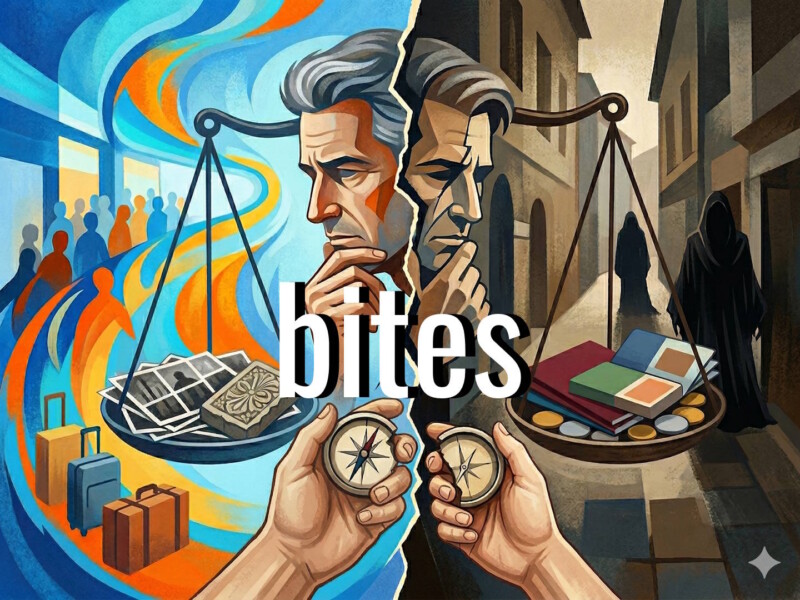
Featured image (top of post)
TBD. A Gemini-generated image. “GT” added the words.