What’s the point of UN Tourism?

What’s the point of UN Tourism?
Thanks to the four good people who responded to this “Good Tourism” Insight Bites question. Their responses appear in the order I received them.
Have a thought to share?
Respond in the comments at any time. Or write a Bite of your own.
Bites menu
Why would anyone question the UN’s value to tourism?
Geoffrey Lipman, Creative Disruption Architect, The SUNx Program, Malta
We have lived for more than 75 years in a post-war peacebuilding and sustainable development global mode in the framework of the United Nations (UN).

This has helped build an increasingly interconnected world, with travel & tourism a vital support mechanism; as, I would assume, all readers of The “Good Tourism” Blog believe and profess.
Tourism formally became part of this framework when Francesco Frangialli brought the then-independent World Tourism Organization (now UN Tourism) in as a specialised UN agency.
This move formally integrated tourism into all the UN programmes that make daily lives better everywhere on the planet: climate resilience, sustainable development, and nature conservation.
It also leads in the common fight for health, poverty reduction, and fair trade.
The global cost is negligible and the benefits immense.
Why would any sane person question this?
UN Tourism: A flawed force for good
David Beirman, Adjunct Fellow, University of Technology Sydney, Australia
UN Tourism (formerly the United Nations World Tourism Organization) has spent too much time in recent years bogged down in controversy over its leadership.

This has diminished its global reputation and its relevance. Key countries, including the United States (USA) and Australia, have not been members for years.
However, UN Tourism remains a force for good.
In 2024, the UN General Assembly devoted a special session to highlighting the cultural and economic significance of sustainable tourism.
UN Tourism has highlighted the significance of tourism to the global economy and provided positive guidance to the global industry and governments during and after the COVID-19 pandemic (2020 – 2023).
It played a valuable role in helping global tourism recover from late 2022.
As a UN agency, it has been vital in commissioning research and developing action programmes to assist national tourism destination management/marketing boards and professionals in developing countries.
This was especially valuable in the post-pandemic recovery phase and effectively applied in the Asia Pacific region in cooperation with Association of Southeast Asian Nations (ASEAN) Tourism, the Pacific Asia Travel Association (PATA), and Asia-Pacific Economic Cooperation (APEC) Tourism.
As UN Tourism largely focuses on government tourism ministries, its work should complement, rather than compete with, that of the World Travel & Tourism Council (WTTC), which focuses on the private sector.
Unfortunately, inflated egos within the leadership of both bodies have limited the collaborative approach to advancing global tourism.
The co-operation which should exist with global sectoral bodies such as the International Air Transport Association (IATA), Cruise Lines International Association (CLIA), and the International Hotel & Restaurant Association (IHRA) needs drastic improvement to serve the interests of the industry.
UN Tourism can’t fix the traveller ‘say-do’ gap
Richard Shepard, Trustee/CEO, Sustainable Rural Development International, England
What is the point of UN Tourism?

If the question relates to the impact of the organisation (formerly the UN World Tourism Organization) and related United Nations (UN) initiatives, then yes, they have influenced sustainable travel.
However, the strength of the evidence and the clarity of causal links vary by programme, region, and outcome.
The impact is most often indirect and mediated through national policies, industry standards, funding mechanisms, and measurement frameworks rather than a single, easily isolated causal effect.
UN Tourism supports and guides national and local policy frameworks for sustainable tourism development. Countries referencing its guidance tend to adopt or align with its sustainability components.
It has contributed to standardising indicators for sustainable tourism measurement. Workshops, training, and technical assistance help destinations improve sustainability practices.
Evidence suggests that travellers are increasingly aware of sustainability, and tourism players respond with greener offerings and eco-certifications.
The organisation’s role in promoting responsible travel and publicising sustainable destinations helps shape consumer expectations and corporate strategies.
But the direct causal link from messaging to consumer demand is hard to quantify, so it may seem that the point of this question is: “What is it worth?”
The answer is that it has an important role.
However, we all know that there is a wide gap between what travellers say they want and what they buy. UN Tourism cannot do anything about that; it is up to the destination.
The point of UN Tourism: Does anyone know? Plus other thoughts
Richard Butler, Emeritus Professor of Tourism, University of Strathclyde, Scotland
I have no idea what the point of UN Tourism is. Does anyone know?

The only potential ‘good’ thing from it is that it could indicate the importance of tourism in more than one respect.
Unfortunately, most of the attention is given to growth and the economic viewpoint.
On travel writing and peace: The recent article on travel writing — “Imagining peace: How travel writing bridges divides between Israel and the UAE” — was one of the very few related to tourism and peace that seemed to make sense.
I still find it a little optimistic.
However, in general, if travel writing is fair and relatively unbiased, then it would seem a positive step and approach.
On AI in academia: Artificial intelligence (AI) has had no impact on my writing; except for annoying offers all the time to have my writing summarised by it.
I also have to tick boxes when doing reviews, promising I have not used AI.
Personally, it remains an unnecessary creation with no real value in academia.
The ‘engine room’ of global tourism?
Gemini AI
To understand UN Tourism is to see travel not just as a leisure activity, but as a serious pillar of global diplomacy and economic survival.

Founded as a private technical body in 1925, it evolved into a United Nations (UN) specialised agency because the post-colonial world realised that tourism provided ‘invisible income’.
This offered a way for developing nations to trade cultural and natural capital for hard currency without the need for heavy industry.
Today, the point of UN Tourism is to act as the industry’s ‘engine room’. It provides the standardised data and legal frameworks that allow 160 member states to speak the same language.
Whether it is through the Global Code of Ethics for Tourism or the Tourism Satellite Account (TSA), the agency ensures that tourism’s contribution to GDP is visible to policymakers.
Crucially, UN Tourism champions the idea that the sector can be a force for peace.
By creating economic interdependence between neighbours and promoting rural development through initiatives like the Best Tourism Villages, it aims to make the ‘cost of conflict’ too high to bear.
However, the agency often faces a ‘rhetoric vs. reality’ challenge.
In 2026, as it praises reforms in nations like Iran while other UN branches condemn human rights crises there, we are reminded that its role is strictly intergovernmental.
It works with states as they are, hoping that the ‘good’ of tourism — jobs, preservation, and exchange — eventually outweighs the friction of politics.
Ultimately, UN Tourism exists to ensure that when we travel, the benefits don’t just stay with the traveller, but serve the host community and the planet.
What do you think?
Share your own thoughts about UN Tourism in a comment below.
SIGN IN or REGISTER first. (After signing in you will need to refresh this page to see the comments section.)
Or write a “GT” Insight or “GT” Insight Bite of your own. The “Good Tourism” Blog welcomes diversity of opinion and perspective about travel & tourism, because travel & tourism is everyone’s business.
This is an open invitation to travel & tourism stakeholders from any background to share their thoughts in plain English with a global industry audience.
“GT” doesn’t judge. “GT” publishes. “GT” is where free thought travels.
If you think the tourism media landscape is better with “GT” in it, then please …
Previous “GT” Insight Bites
- Tourism’s biggest threats, opportunities: five years to 2030
- Do fun and politics mix? Can we ‘leave our cares behind’ when we go on holiday?
- Overtourism and overimmigration are the same?
- What is ‘authenticity’ in travel & tourism?
- Undertourism: Who’s suffering, and why?
- Tourism, war, and peace
- Signalling or substance in tourism: What’s your take?
- Visitor value, values, volume: What’s good where you are?
- Outbound doesn’t care about sustainability | Well-being must include meaning
- Is a travel & tourism career still attractive? Important things to understand in 2025
- Wishwashing tourism
- Butler’s conundrum: Air travel and ‘sustainable’ tourism
- What is tourism’s biggest opportunity and/or threat where you are in 2025?
- “GT” Insight Bites: Nostalgia
- “GT” Insight Bites: Geopolitics and tourism
- Tourism stakeholders: Who has an outsized voice? Who has no voice? Who cares?
- Would you abolish taxes on tips?
- Three critics walk into a bar …
- How are emerging technologies transforming the travel & tourism industry?
- What does it mean to be critical of tourism?
- What constitutes ‘progress’ for travel & tourism in 2024?
- Considering a career in tourism? Important things you should know in 2024
- What did tourism learn from the COVID-19 pandemic?
- In 2024, what are the best opportunities for tourism over the next five years?
- Tourism’s biggest challenges & threats over the next five years to 2028
- On empowerment, promotion, and the power of expression
- On enrichment, repatriation, the double-edged blade, and war
- On tourism technology, progress, and local benefit-sharing
- Hey, travel & tourism, are you ‘neocolonialist’?
- Who’s the new boss? Asia Pacific tourism industry association seeks leader
- ‘The hospitality industry offers a great career.’ Really?
- Cruise ships: Blessing or blight?
- Tourist vs traveller: What’s the difference?
- The heads of finance, operations, and PR walk into their boss’s office …
- Yes, Tourism Minister
- What are tourism’s biggest challenges & threats over the next five years?
- ‘Tourism is built on the backbone of white supremacy’. What do you think?
- Really, what’s the difference? ‘Sustainable tourism’ vs ‘regenerative tourism’
- Want a career in tourism? Important things you should know
- Diverse perspectives on travel & tourism and a fairer world
- Diverse perspectives on economic degrowth and tourism
- Diverse perspectives on visitor dispersion
Featured image (top of post)
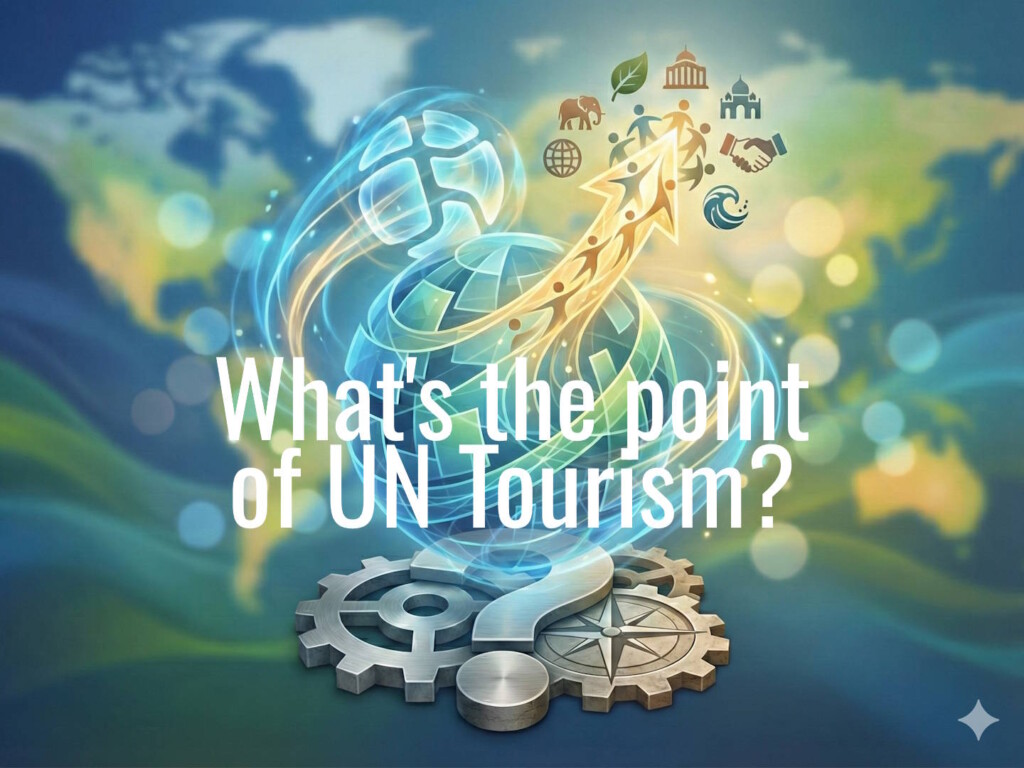
What’s the point of UN Tourism? A Gemini-generated image. “GT” added the words.