The flaw in sustainability: Why responsible tourism avoids hard questions

Ewan Cluckie argues that travel & tourism’s sustainability claims have created a credibility crisis, and that it is time to ask hard questions about ownership, governance, and incentives.
It’s a “Good Tourism” Insight. (You too can write a “GT” Insight.)
Sustainability: Much talk, declining trust
The travel industry talks a lot about sustainability. We publish policies, track emissions, create certifications, and promote best practice.
Yet trust in sustainability claims is declining, and scrutiny from regulators, consumers, and partners is increasing.
This disconnect raises an uncomfortable question: if we have more sustainability frameworks than ever before, why does credibility still feel so fragile?
One answer is that much of the industry’s sustainability conversation focuses on outputs rather than inputs. We measure what businesses say they do, but rarely examine how they are designed to behave when commercial pressure rises.
Sustainability has become a marketing function rather than an operational commitment.
The limits of sustainability as it is commonly practised
Most sustainability frameworks in tourism evolved from environmental management systems. They are built to assess activities, policies, and metrics.
These tools are useful, but incomplete. They tell us how a business operates today, not whether it is structurally obligated to act responsibly tomorrow.
When sustainability is treated primarily as a set of practices, it becomes vulnerable. Environmental commitments can be deprioritised. Social standards can be diluted. Policies can be rewritten.
This is not because individuals suddenly stop caring, but because the underlying incentives remain unchanged. We saw this first-hand back during the pandemic.
If ownership structures, governance arrangements, and profit expectations reward short-term extraction, sustainability commitments will eventually be tested and compromised.
The questions we tend not to ask
There are several questions that rarely sit at the centre of responsible tourism discussions:
- Who owns the business, and where are strategic decisions made?
- Who ultimately benefits when the business succeeds?
- How are profits distributed, and where do they flow?
- What happens to sustainability commitments when margins tighten or shareholders push for growth?
These are not abstract concerns.
In many destinations, including across Southeast Asia where I work, issues such as opaque ownership structures, uneven enforcement of labour standards, and limited retention of tourism value within local economies are well documented.
Yet they are often treated as separate from sustainability, rather than central to it.
As a result, a business can present strong environmental performance claims, while remaining structurally misaligned with the long-term interests of the places it operates in.
The gap between standards and assurance
If certifications are to be meaningful, they must do more than assess what businesses claim. They must provide assurance that those claims hold up under scrutiny.
In practice, this often does not happen.
Some certification frameworks include robust standards on paper, covering areas such as legal compliance, non-discrimination, and fair labour practices. Yet the depth of auditing does not always match the breadth of the standards.
Businesses may be certified despite operating through ownership arrangements that raise questions about compliance with local law. Or they may operate with workplace cultures or tax practices that would not hold up to close scrutiny against the framework’s own criteria.
This is not necessarily a failure of intent. Audits often rely on self-reported information and declarations, and verifying compliance with destination-specific laws requires expertise and resources that many certification bodies may not prioritise.
But the end result is the same.
When a certification endorses a business that does not meet its own stated standards, it lends credibility to practices that truly responsible operators are working to move beyond.
Certification bodies also have their own structural tensions at play. Those that measure success by the number of businesses certified face pressure to grow.
But growth without rigour or integrity to principles dilutes value.
The industry would be better served by frameworks that prioritise depth of assurance over breadth of membership, even if that means fewer businesses qualify.
The case for transparency
One way to address this would be greater transparency in the certification process itself.
At present, most audit outcomes remain confidential. Businesses display a badge, but stakeholders have no visibility into how that badge was earned, what was assessed, or what gaps may have been identified.
If the claims being certified are genuine and can withstand public scrutiny, there is little reason for this information to remain hidden.
Publishing audit methodologies, findings, and areas of non-compliance would allow partners, regulators, and consumers to make informed judgements rather than relying on the badge alone.
Transparency also shifts incentives.
When audit outcomes are public, certification bodies face greater accountability for the rigour of their processes. Certified businesses face greater accountability for the accuracy of their claims. And the wider industry gains a clearer picture of what certification actually means in practice.
Why regulation is shifting the burden
This gap between stated standards and verified practice is becoming harder to sustain.
In Europe, the Corporate Sustainability Reporting Directive and the proposed Green Claims Directive are raising expectations around evidence, accuracy, and accountability.
The Package Travel Directive already places due diligence obligations on organisers to ensure suppliers meet legal and contractual standards.
Together, these frameworks signal a broader shift: sustainability claims must be defensible, and liability increasingly flows through supply chains.
For travel brands and intermediaries, this introduces new forms of risk.
Aligning with suppliers whose sustainability narratives cannot withstand scrutiny, or whose structures undermine their stated values, exposes partners to reputational and regulatory consequences. This is true even when the marketing language sounds reassuring.
Moving from practices to structure
If the industry wants to rebuild trust, it may need to move beyond asking whether a business follows responsible practices, and start asking whether it is designed to do so.
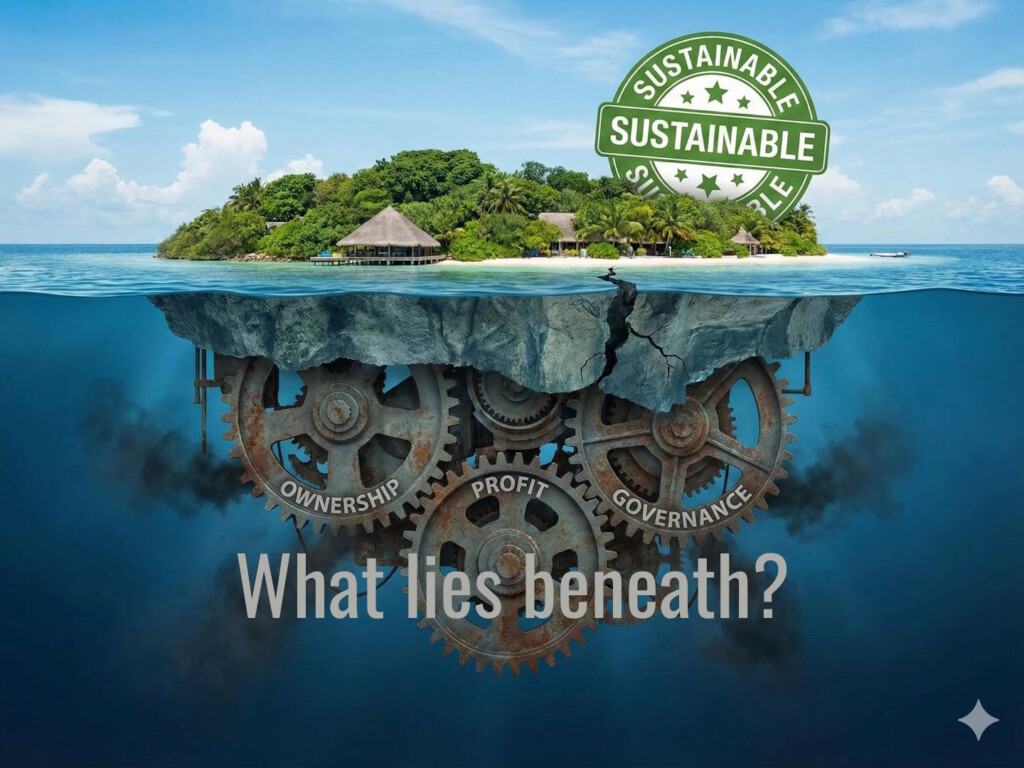
This means paying greater attention to company structure. Ownership models. Governance safeguards. Profit distribution. Decision-making power.
These elements shape behaviour far more reliably than policies alone.
Some operators are now looking beyond traditional sustainability certifications toward verification frameworks that assess structure and governance, not just claims.
The question is not whether a company has a sustainability policy, but whether that policy can survive a change in leadership, a squeeze on margins, or pressure from investors.
At Tripseed, this thinking led us to pursue People and Planet First verification, which examines our organisational and governance structures rather than operational checklists.
Being among the first travel companies in Asia to achieve this recognition is not an endpoint. It is part of a broader effort to test whether our commitments are genuinely embedded, and to contribute to a conversation about what credible assurance might look like.
A more honest phase of responsible tourism
Responsible tourism does not need more badges. It needs greater honesty about the limits of existing approaches, and more willingness to address the structural drivers of impact.
This does not mean every tourism business must become a social enterprise. But it does mean acknowledging that sustainability without structural accountability is fragile.
Credibility increasingly depends on whether responsibility is embedded into the very roots of a business rather than layered on top.
As scrutiny grows and expectations shift, the industry faces a choice. Continue refining sustainability narratives that sit comfortably within existing structures, or begin asking harder questions about how tourism businesses are owned, governed, and incentivised.
If responsible tourism is to move from promise to practice, it may be those harder questions, not the next certification, that matter most.
What do you think?
Share your thoughts in a comment below about sustainability certification, and policies and governance around responsible tourism.
(SIGN IN or REGISTER first. After signing in you will need to refresh this page to see the comments section.)
Or write a “GT” Insight or “GT” Insight Bite of your own. The “Good Tourism” Blog welcomes diversity of opinion and perspective about travel & tourism, because travel & tourism is everyone’s business.
“GT” doesn’t judge. “GT” publishes. “GT” is where free thought travels.
If you think the tourism media landscape is better with “GT” in it, then please …
About the author

Ewan Cluckie is Chief Growth Officer at Tripseed, a ‘People and Planet First-verified’ social enterprise and destination management company based in Chiang Mai, Thailand.
His work centres on “principled company growth led by long-term social, economic, and environmental impact”.
Featured image (top of post)
The flaw in sustainability: Why responsible tourism avoids the hard questions. A Gemini-generated image.