Is there a right to travel or be a tourist in a world of limits?


Is travel & tourism a human right or elite privilege? As residents protest against overtourism and destinations introduce visitor caps, is it time to rethink our freedom of movement?
Ralf Vogler, Nadja Schweiggart, and Adrian Müller outline how we might distinguish between necessary travel and discretionary tourism consumption and propose a ‘staircase model’ of ascending justifications.
It’s a “Good Tourism” Insight. (You too can write a “GT” Insight.)
The authors have contributed this “GT” Insight at the invitation of Tourism’s Horizon: Travel for the Millions, a “GT” Insight Partner.
Is there a right to travel & tourism?
The question may sound abstract, but it becomes very practical when destinations introduce visitor caps, cities regulate short-term rentals, ports restrict cruises, or residents protest against overtourism.
These are signs that tourism is entering a new political phase: one in which growth is no longer automatically treated as desirable, and limits are becoming part of policy debates.
From our point of view, travel & tourism should not simply be restricted from above.
Instead, we ask how travel & tourism freedom can be rethought through liberal principles: as a valuable freedom, but one that must be justified in relation to the freedoms of others.
Why the question matters now
This shift is uncomfortable because travel & tourism is tied to emotions.
For many people, holidays mean rest, family time, discovery, freedom, and participation in a good life. For destinations and businesses, travel & tourism means jobs, income, investment, and development.
That is why restrictions, or even attempts to introduce them, often trigger strong reactions.
When access is limited, travel is quickly defended as something people have earned, something normal, and sometimes almost as a right.
This is the starting point of our article in the Annals of Tourism Research. We ask why travel & tourism is so often treated as something sacred that is difficult to restrict.
The question matters because tourism is increasingly confronted with two types of limits.
First, planetary boundaries are being exceeded, which means that emissions, resource use, and carbon-intensive mobility can no longer be treated as secondary concerns.
In addition, conflicts in destinations are becoming more visible as travel & tourism affects housing, public spaces, infrastructure, and residents’ quality of life.
Together, these pressures make regulation and new policy approaches more likely. But when tourism is defended as a ‘right’, such measures quickly appear as attacks on freedom.
To analyse this tension, we examine the ‘right to tourism’ through four lenses: historical, structural, legal, and normative-ethical.
What is actually being defended?
The phrase ‘right to tourism’ sounds clearer than it is. It brings together several claims that need to be separated.
- There is the freedom of movement: the right to move within a country, to leave it, and to return.
- There is the right to rest and leisure, including paid holidays. There is the social argument that holidays should not be reserved for elites.
- And there are the economic interests of destinations, businesses, and workers who depend on travel & tourism.
All of these claims matter. But they are not the same.
Freedom of movement is not identical to tourism. Paid holidays give people time away from work, but they do not create a right to consume any specific form of travel.
Social inclusion is important, but it does not make every travel & tourism practice equally defensible. Economic benefits matter, but they do not automatically override ecological limits or residents’ concerns.
This distinction is central. The article does not argue against tourism, leisure, or mobility. It argues against treating these different ideas as if they added up to an unlimited right.
Once they are bundled together, a policy debate about specific pressures can quickly become a much broader debate about freedom itself.
How travel & tourism became normal
The reason this debate is so sensitive is historical.
Modern travel & tourism became normal through social, political, and economic change: paid holidays, shorter working hours, rising incomes, welfare-state arrangements, cheaper transport, and more open borders.
What had once been an elite privilege gradually became a widely shared expectation.
This was a real social achievement. Access to holidays expanded rest, recreation, and mobility to many more people. It helped make travel & tourism part of modern life and linked it to ideas of fairness, progress, and social participation.
But this achievement is now embedded in a travel & tourism system built around growth and economic success. Destinations, transport providers, platforms, marketing organisations, and policy frameworks all help make frequent and long-distance travel normal, desirable, and economically important.
As a result, travel & tourism is not only chosen by individuals. It is also produced by structures that make various forms of travel economically accessible, convenient, and expected.
That is why the question cannot be reduced to consumer behaviour. Yes, travellers make choices. But those choices are shaped by infrastructures, business models, prices, marketing, and policy.
If the travel & tourism system continues to define success mainly through more arrivals, more overnight stays, and more spending, it will keep reproducing the very pressures it claims to manage.
From entitlement to justification
Finding solutions to these tensions is difficult. If technology is too slow and voluntary behaviour change is insufficient, travel & tourism policy has to address limits more directly.
The central question is therefore not simply whether travel & tourism should be allowed or restricted. It is which forms of travel are justifiable, for which purposes, under which conditions, and at what and whose cost.
A liberal argument starts from the importance of freedom. People are and should be free to move, rest, travel, and take part in social life.
But liberal freedom does not mean that every individual’s wish automatically overrides the rights and freedoms of others. Individual freedom has limits when it conflicts with others’ freedom. As a consequence, different forms of travel should not be treated as identical.
Visiting family, studying abroad, travelling for medical reasons, attending a necessary business meeting, taking a short-haul weekend flight for entertainment, or joining a cruise in an already overcrowded city involve different purposes, alternatives, and impacts.
A serious travel & tourism debate must be able to make these distinctions rather than treating every restriction as a general attack on freedom.
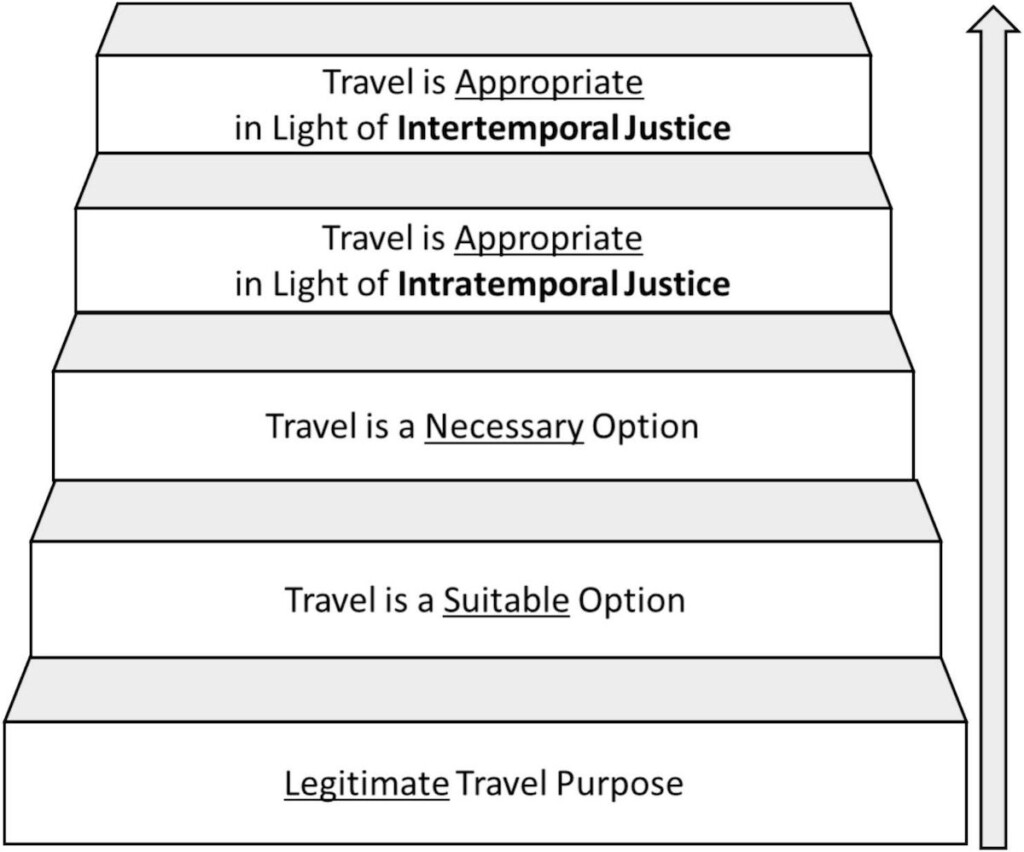
This is why we propose a staircase model for relationally justified travel.
The staircase model: Justice in travel & tourism
Our staircase model asks whether a form of travel is legitimate in purpose, suitable for achieving that purpose, necessary compared with alternatives, proportionate in relation to ecological and social impacts, and justifiable in view of future generations.
The model is not a ban or a quota system. It is a way to make difficult decisions more transparent without advocating for a general limit or restriction.
To understand the responsibilities inherent in travel, we distinguish between two fundamental frameworks:
- Intragenerational justice (‘justice for today’): This refers to fairness in the distribution of resources, opportunities, and environmental impacts among people living now; across and within countries and social groups.
- In travel & tourism: This means ensuring travel does not unjustifiably harm communities today. For example, when cruise passengers in Dubrovnik overwhelm local infrastructure or residents’ quality of life, they trigger debates about intragenerational equity. These tensions are often the primary drivers behind recent anti-tourism protests.
- Intergenerational justice (‘justice for tomorrow’): This refers to fairness between present and future generations. It emphasises our responsibility to preserve environmental, social, and economic conditions so that future people can meet their own needs.
- In travel & tourism: This means travelling in a way that does not steal from the future. For example, carbon-intensive transport contributes to climate change and the destruction of living spaces in regions like the Maldives. This impact threatens the very ability of future generations to inhabit their homelands.
What kind of travel & tourism deserves support?
The implication is clear: policy actors will increasingly have to explain which forms of travel & tourism should be supported, redirected, taxed, limited, or discouraged.
This does not require abandoning liberal principles. On the contrary, it requires taking them seriously. A liberal solution is not simply to prohibit travel. It is to create fair, transparent, and publicly justifiable rules that allow travel & tourism freedom to continue without undermining the freedoms of others.
That means asking not only what travellers want, but also what host communities can bear, what ecological limits allow, and what future generations should not be deprived of.
For destinations, success can no longer be measured only in arrivals, overnight stays, and spending. Resident acceptance, emissions, resource use, housing pressure, and long-term resilience also matter.
For businesses, this is a strategic issue: regulation, social acceptance, mobility constraints, and climate policy are becoming part of travel & tourism’s operating environment.
For travellers, the implication is not guilt, but responsibility: how is this travel justified in relation to its purpose, impacts, and alternatives?
Travel & tourism is and will remain important. It can contribute to wellbeing, learning, livelihoods, exchange, and development.
But in a world of ecological limits and growing social conflicts, its legitimacy will depend less on claiming that travel & tourism is a right, and more on showing which forms and reasons for travel and tourism are worth defending.
The debate should therefore not be framed as travel & tourism versus restriction.
The more useful question is: how can travel & tourism freedom be organised so that it remains possible, meaningful, and legitimate in a world of limits?
What do you think?
Share your thoughts in a comment below about the right to travel or to be a tourist, and who should determine that. All perspectives are welcome because travel & tourism is everyone’s business.
(SIGN IN or REGISTER first. After signing in you will need to refresh this page to see the comments section.)
Or write a “GT” Insight or “GT” Insight Bite of your own. The “Good Tourism” Blog welcomes diversity of opinion and perspective about travel & tourism, because travel & tourism is complicated.
“GT” doesn’t judge. “GT” publishes. “GT” is where free thought travels.
If you think the tourism media landscape is better with “GT” in it, then please consider supporting “GT” via a Partnership and/or …
About the authors

Ralf Vogler is a Professor at the Institute of Tourism, Travel & Hospitality (ITTH) at Heilbronn University of Applied Sciences, Germany.
Prof Vogler’s research focuses on tourism policy and tourism development. Currently, he is investigating a variety of power- and justice-related aspects of societal conflicts in tourism and transformation processes.

Nadja Schweiggart is a postdoctoral researcher at Linneaus University, Sweden, specialising in sustainable tourism and transport and how tourism is entangled with broader societal developments and the political arena.
Dr Schweiggart’s research focuses on issues such climate justice, tourism politics, sustainable mobility, activism within tourism, and integrating animal justice into tourism studies.

Adrian Müller is a scientific project leader at the tourism research unit at University of Bern, Switzerland.
Dr Müller’s research concentrates on sustainable travel behaviour, with particular emphasis on decarbonising business travel and long-distance mobility. He is especially interested in how organisational conditions, systemic factors, and individual decision-making interact to shape travel behaviour and how this can be managed.
Adrian’s current work also investigates climate justice in tourism, public debates about high-carbon travel, broader societal norms and expectations around travel, and how organisations adopt low-carbon mobility solutions.
The authors have contributed this “GT” Insight at the invitation of Tourism’s Horizon: Travel for the Millions, a “GT” Insight Partner.
Featured image (top of post)
Is there a right to travel or be a tourist in a world of limits? A Gemini-generated image. “GT” added the words.