Governance bottlenecks are slowing Kenya’s sustainability progress: How to break them


The ‘say-do gap’ in sustainable travel & tourism is not only an issue in consumer decision-making and capital allocation. It is also an institutional, bureaucratic, and political problem.
As Doreen Nyamweya has discovered through her experience in local government in Kenya, progress towards sustainability is possible, but never swift nor perfect.
It’s a “Good Tourism” Insight. [You too can write a “GT” Insight.]
Sustainability is political before it is technical
Like many sustainability professionals, I entered public service believing that scientifically sound policies, logic, and technical expertise would naturally drive progress.
I was wrong. I quickly realised that sustainability is political before it is technical.
My experience working with a local government in Kenya revealed how structural sustainability challenges play out in practice.
Implementation continues to lag ambition
Kenya has positioned itself as a regional leader in sustainability, with ambitious green energy investments and national climate commitments aimed at building resilience.
The barrier to sustainability is no longer primarily technical. Kenya already possesses the expertise, policies, and technological innovations necessary to support a greener transition across multiple sectors, yet implementation continues to lag ambition.
A 2025 CSIS (Centre for Strategic and International Studies) report highlights Kenya’s struggle with persistent implementation gaps between high-level policy ambition and the practical execution for resilience building.
The greater hindrance lies within governance systems that slow coordination, weaken accountability, and delay execution across all levels of government. Political cycles, fragmented decision-making structures, inconsistent policy enforcement, and competing development priorities continue to shape the pace of sustainability integration.
As Kenya accelerates this transition, the conversation must move beyond innovation to confront the institutional realities determining whether sustainability goals are achievable.
These governance realities are especially visible within sustainable travel & tourism initiatives, where conservation goals, community expectations, and local political interests frequently intersect; like in the case of the Amboseli National Park handover to Kajiado County, where management is expected to champion community-centric tourism and end a historical injustice.
As I have witnessed, even the strongest sustainability strategy can collapse if it does not survive departmental zero-sum budget battles or shifting political interests. Hence, inside many government offices, logic alone rarely determines outcomes.
At some point, sustainability itself can cease to be the immediate priority. Competing institutional interests take precedence. Adaptability becomes a higher-order skill than technical expertise alone.
Sustainability is a language problem
Within many government institutions, sustainability is perceived as expensive. To move sustainability from theory to practice, the vocabulary itself must change.
Discussions centred on environmental terminology or carbon offsetting targets rarely gain traction in political environments focused on the public mood and electoral viability. The constraint is rarely about a lack of awareness; it is a clash of incentives.
Long-term conservation projects frequently require political leaders to exchange immediate political capital for benefits that may only become visible years later. In current election cycles, this is often a losing trade. In many cases, visible infrastructural projects are prioritised because they generate immediate public recognition and electoral advantage.
I learnt this firsthand when discussing sustainability initiatives with colleagues whose priorities were dominated by employment concerns, public service delivery, and visible development outcomes. Conversations became more productive when sustainability was framed not as climate action alone, but as tourism revenue protection, cost savings, or long-term economic resilience. This has changed how I approach policy conversations.
As a result, sustainability experts often spend more time understanding power dynamics and institutional priorities than refining technical policy design.
You rarely succeed by simply being ‘right’. Progress comes from identifying the individuals who perceive the status quo as a threat to their own interests, and aligning sustainability goals with their incentives.
Institutional change depends on trust
Government institutions do not respond to disruption in the same way private sector organisations do. During interdepartmental engagements, I noticed technically viable proposals moving slowly, not because stakeholders fundamentally opposed them, but because there was insufficient institutional trust behind the people advancing them.
Evidently, relationships mattered as much as evidence. Real change requires buy-in from stakeholders who have already witnessed repeated waves of ‘innovation’. Otherwise, proposals that lack this kind of support are approached with scepticism.
Without trust, even well-designed policies become trapped in procedural slowdowns. At that point, weaponising the technical complexity of sustainability becomes ineffective.
If stakeholders are hesitant to support a project directly, implementation can be slowed by extended administrative and review processes, in the guise of effective governance.
Building social capital therefore becomes vital to implementation. In practice, this entails engaging in trade-offs. It means supporting broader institutional priorities alongside sustainability goals, building goodwill with my colleagues that may later strengthen institutional backing for sustainability initiatives when resistance inevitably emerges.
Community voice is the best form of leverage
Community participation remains one of the strongest forms of leverage available to sustainability advocates. It creates legitimacy, which in turn generates political pressure that institutions cannot easily ignore. It shifts sustainability from agenda item to political priority.
The conservancy management model in Kenya (the 2016 Community Land Act) establishes a legal framework that gives communities access to legal land rights and active participation in making decisions on land allocation and use. Through local participation, conservation dialogues have shifted from government imposition on community lands to supporting community conservancy development.
Leaders will act when reforms carry social approval and reputational consequences. But sustainable reform is rarely achieved through individual effort alone. Collective responsibility strengthens implementation, distributes risk, and builds resilience. Long-term implementation depends on cooperation between government agencies, communities, civil society organisations, and private-sector actors who collectively view reform as beneficial.
I often witnessed local participation fundamentally change the trajectory of sustainability discussions. When communities articulated how environmental degradation directly affected livelihoods, tourism income, water access, or local economic stability, sustainability conversations became more politically urgent and less theoretical.
To leverage this potential, forums must be created in which local stakeholders can pitch solutions to the administration and participate directly in decision-making. Inclusive engagement builds trust, improves transparency, and creates shared responsibility for smooth implementation. In the end, this reduces government scepticism toward reform efforts. And the sustainability advocate is no longer the only voice in the room.
Sustainability is an iterative process, not a destination
Sustainability is an incremental process rather than a fixed point of arrival.
Many sustainability experts anticipate implementing perfect sustainability policies and models on day one. However, governance realities rarely accommodate perfection. Over time, you notice that ‘perfect’ is the enemy of the ‘possible’. Small, incremental wins are the foundation for broader structural change.
While progress may appear slow, these smaller victories help build institutional familiarity, political confidence, and long-term acceptance of sustainability practices within government systems.
Advancing sustainability within government institutions is not about winning a single argument. It is about maintaining professional integrity, navigating institutional realities, and consistently reframing the conversation until ‘sustainability’ is no longer treated as a niche concern, but as part of everyday governance.
The sweeping paradigm shift promised in sustainability brochures may never fully materialise. But replacing idealism with strategy offers something equally important: a seat at the table where long-term decisions about development and governance can be negotiated.
What do you think?
Share your thoughts in a comment below about sustainable tourism’s political and institutional ‘say-do gap’, especially if you are a stakeholder in Kenya. All perspectives are welcome because travel & tourism is everyone’s business.
(SIGN IN or REGISTER first. After signing in you will need to refresh this page to see the comments section.)
Or write a “GT” Insight or “GT” Insight Bite of your own. The “Good Tourism” Blog welcomes diversity of opinion and perspective about travel & tourism, because travel & tourism is complicated.
“GT” doesn’t judge. “GT” publishes. “GT” is where free thought travels.
If you think the tourism media landscape is better with “GT” in it, then please consider supporting “GT” via a Partnership and/or …
About the author

Doreen Nyamweya, Tourism Officer in Nyamira County, Kenya, is a sustainable tourism specialist and a student and advocate of responsible tourism management.
Ms Nyamweya’s areas of expertise include tourism research, destination management, sustainability assessment, product development, and responsible tourism marketing.
Featured image (top of post)
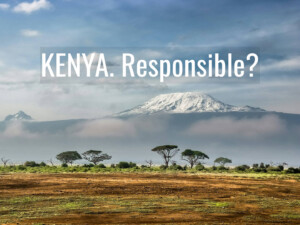
Governance bottlenecks are slowing Kenya’s sustainability progress: How to break them. A Gemini-generated image. “GT” added the words.