Re: Ecotourism

Several speakers considered what ecotourism might look like post-COVID and explored “revolutionary” ideas during the second day of the 2020 Global Eco Asia-Pacific Tourism Conference. And, predictably, there were lots of other “re-” words bandied about — Reset. Rethink. Redesign. Reflect. Reboot. Regenerate. … — words better applied to the travel industry at large rather than the “eco-” niche; or one would have thought.
Yet, apparently, the ecotourism sector has slipped in its standards in recent years … well, if not standards, then certainly passion. Prof Ross Dowling AM, Honorary Professor of Tourism, School of Business & Law at Edith Cowan University and co-convenor of the event, remarked about it. He observed that there was an inspiring injection of passion in the presentations this year; to a degree, perhaps, he had not seen since he was starting out.
It was a day of lots of short, sharp presentations; wide-ranging in scope. Below are a few highlights of the day’s program; “highlights” in terms of your correspondent being alert enough to take sensible notes that could be of use or interest to you, dear reader.
Among the talks not referenced below were stories — absorbing and inspiring — for which you really had to be there, such as the one by Gary Muir of WOW Wilderness in Walpole, Western Australia. Then there were sermons that may have had good points buried within them under silly slogans of fashionable virtue. And there were talks your correspondent simply missed … Sorry!
Re: “Re-”. How?

Re some of the “re-” words, TRC Tourism consultant Penny Spoelder asked and tried to answer the question: “How?” The United Nations’ Sustainable Development Goals (SDGs), she reckons, set the “right foundation” and point to a “good direction”. We need stronger destination management, she said, a component of which might include aligning with community needs through engagement, such as by using “GT” Insight Partner Planet Happiness’ survey tools.
Build back for climate
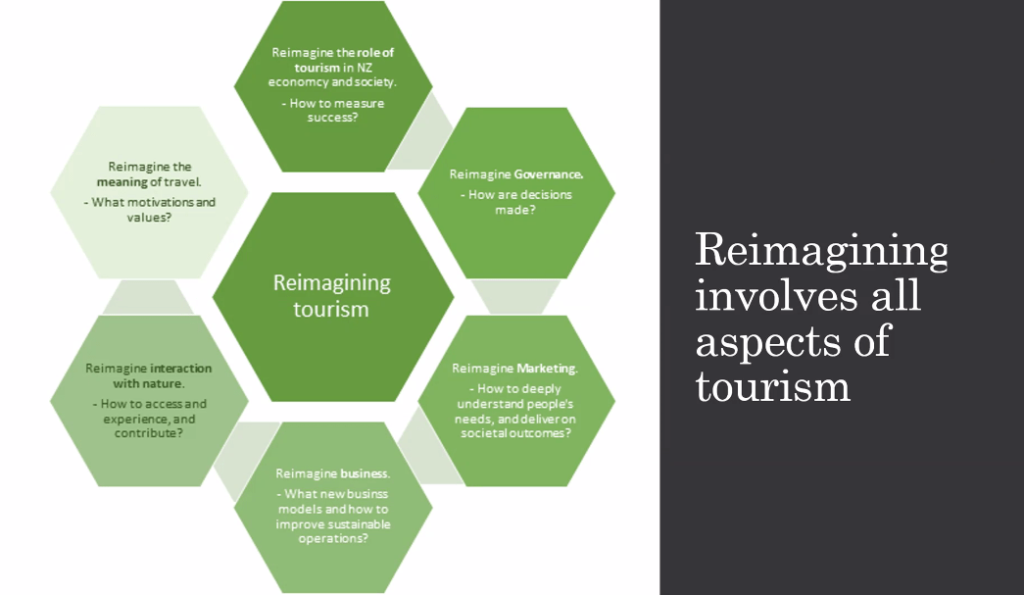
“GT” Friend Susanne Becken of the Griffith Institute for Tourism spoke about New Zealand, a destination that pre-COVID was “reaching carrying capacities” and was figuring out how to deal with overtourism. Now it’s “reimagining” tourism.
More broadly, Prof Becken would like to see tourism build back with climate change in mind. CO2 emissions might be down 7% in 2020, she said, but that needs to be the target every year … But how sustainable is that, really? How much of finite fiscal stimulus is linked to taking action or mitigating climate change?
Tourism before the pandemic had become extractive rather than regenerative but Prof Becken sees hope in the following four points:
- Tourism that is closer to home — smaller carbon footprint; greater resilience; slower travel; decreased impacts of future pandemics
- Tourism that is of higher value, less volume — How to define value? By the terms of locals, which means …
- Host communities need a greater say in tourism policy and planning
- Give nature a seat at the table
On the last point, your correspondent asked: Who gives voice to nature? Might it be local scientists? Prof Becken indicated that it was a work in progress. In addition to scientific measures of nature’s health status, New Zealand was exploring Indigenous knowledge; how the environment “feels” to traditional landowners.
A 30-year-old idea
Innes Larkin, proprietor of Mt Barney Lodge in Queensland, spoke of climate action as a 30-year-old idea. Protesting for wilderness conservation is not bludging, he reckons; precious places owe a debt of gratitude to so-called greeny, hippy, dole-bludging protestors. He spoke passionately about the ecotourism sector stepping up to lead climate action. “Let’s turn the climate change ‘debate’ into an ecotourism led revolution.” In a Q&A later, Mr Larkin clarified that he reckons there is no longer any debate about the scientific fact of (anthropogenic) climate change.
Crisis management
Crisis management was the focus for TRC Tourism consultant Chris Rose, who said the goal of crisis management was to mitigate disruption and problems. The crisis management process, of course, starts well ahead of any crisis event and is ongoing. Crisis management is as much about preparing for crises as it is about managing the aftermath of a crisis-inducing event. Preparation means understanding both risks and risk appetite; determining the range of controls and levers available; establishing strong relationships and lines of accountability and governance; and ensuring it is all tied together with effective lines of communication and messaging. Part of risk management is understanding the difference between hazards and risks; consequences and likelihoods.
Mr Rose offered pointers to what a destination with an effective crisis management plan would have and do:
- Regularly communicate with industry, both formally and informally
- Document risk assessment
- Have policies and plans and protocols ready to roll out for “little things” like refunds and re-bookings and repatriations etc
- Communicate hard and early and honestly when crisis strikes
- Continually feed information to media to maintain control of the narrative
- Pathway to recovery
- Feedback loop
Building confidence
When considering how to rebuild tourism after a crisis, Gabby Walters of the University of Queensland asked and answered the sensible question: Why do tourists avoid destinations affected by crisis?
- It might be depressing there
- Concerns about their own safety and well-being
- Confusion about conditions on the ground
- A belief they would be unwelcome or in the way
Thus it behoves tourism stakeholders seeking to rebuild demand to allay those perfectly understandable concerns and build confidence in the prospective traveller:
- Maintain an online presence for those planning future trips
- Tell inspirational and positive stories
- Emphasise the benefits of visiting
- Showcase cultural experience
- Institute fair booking and cancellation policies
- Keep markets updated on your readiness to welcome visitors
- Reassure those concerned about health and safety
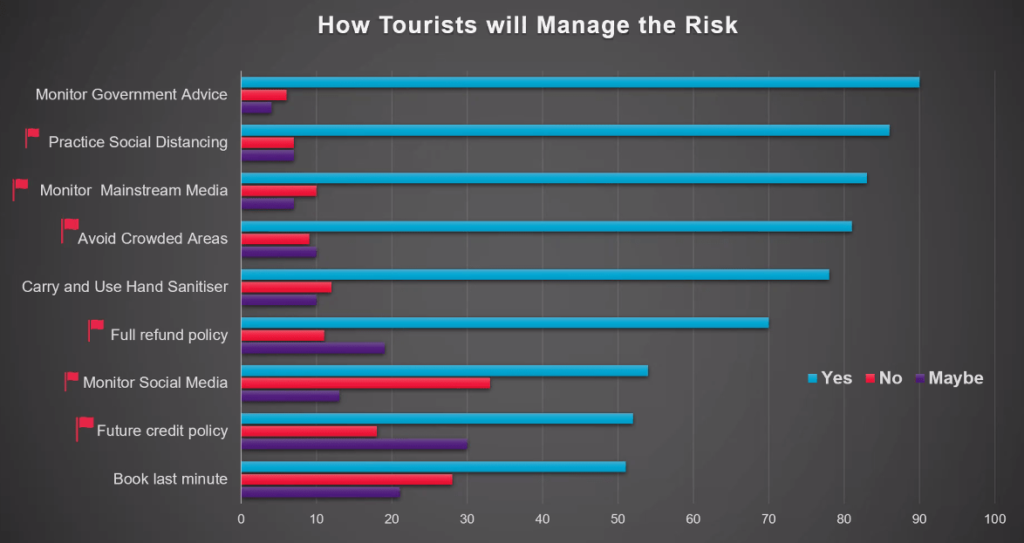
There are opportunities right now for ecotourism operators, including a new appreciation among Australian domestic travellers for domestic travel generally: Australia’s cultural experiences; regions and coasts; the great outdoors and open spaces. The local industry also enjoys the trust of Australians, the luckiest of whom have even more discretionary income than before COVID. Furthermore, as international borders start to reopen, Australia will be seen as among the world’s safest destinations for international travellers.
More space
Dr Sarah Gardiner, deputy director at the Griffith Institute for Tourism delivered a stats-based presentation. In about 2007, for the first time, the number of Australians departing Australia exceeded the number visitors departing Australia to return home. Due to COVID, 2020 has seen a return to Australians exploring their own backyard. And consumer sentiment is clear: Smaller experiences in less populated areas are receiving generally more positive reviews than busier attractions in busier places. This is a clear opportunity for ecotourism, but is it also an opportunity to reshape high-volume experiences?
Small changes, big differences
In 2020, thanks to COVID, Australian Luxury Escapes had to transition into the domestic market from its usual high-yield North American market. Director of the Sydney-based outfit, Grant Charlesworth, reckons travel expectations among Australians have changed, yet he reckons businesses need only make “small changes” to have a “big difference” on viability and profitability:
- Upgrade your product offering to a more upmarket experience. Add value to charge extra or build into price. Collaborate and package.
- Review distribution. Work with a domestic travel wholesaler if you’re not already. Prepare for the return of the international market. Work out your niche and the best distributor(s) for that niche.
- System development, especially for customer relationship and retention. Contact customers to thank them for their business. Send only relevant content to your customer mailing list. Leverage social media — at minimum use Facebook; also the visual medium of Instagram — and engage regularly.
- Upgrade customer service. Tourism is a service industry!
“With disruption comes opportunity,” he said. Ecotourism operators are well positioned because the experiences they offer in Australia are sought after by Australians.

The role of government
Rod Quartermain of Tina Smitherman Consultants said ecotourism can move a lot of things forward, but first it has to be taken seriously. For that it needs to take itself and its people seriously. He reckons more full-time, decent-paying jobs will encourage the government to take notice. In Western Australia, for example, mining employs much fewer people than tourism yet it is represented by a much more senior ministerial portfolio.
On government bureaucracy, Mr Quartermain said green tape was friendly for ecotourism businesses; it preserves the product and is a barrier to entry to those who might degrade it. But red tape, while there are often good reasons for it, can get in the way. He related an example of a development application rejected time and again. As a consultant he asked the authority: “Is there a solution?” “Yes.” “Have you told the applicant what that is?” “Not my job.”
Dr Erika Jacobson, owner/operator of Edgewalkers, made a similar point: There are too many official government and non-governmental bodies to have to deal with, especially for a micro or small business.
The 2020 Global Eco Asia-Pacific Tourism Conference is taking place December 1 – 3, 2020 in Margaret River, Western Australia.
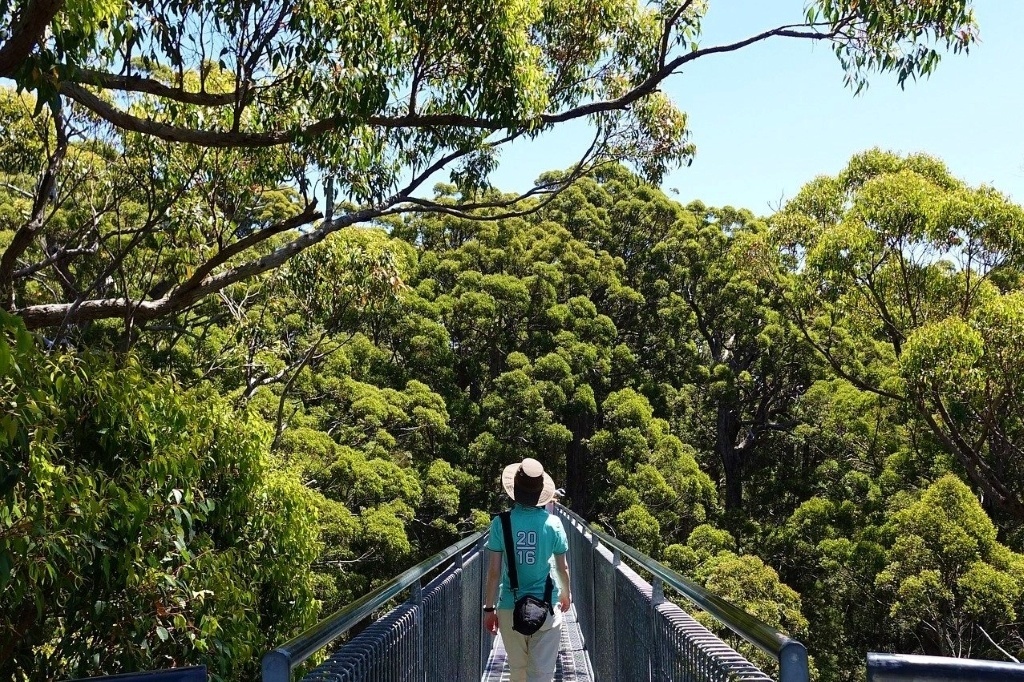
Featured image (top of post): Valley of the Giants Tree Top Walk, Walpole, Western Australia. Image by Komkick (CC0) via Pixabay.